Key Takeaways
- The truly national shortlist is short. Orkin, Terminix Commercial, and Rentokil have broad U.S. commercial operations, while regional names like Massey, Arrow, and Plunkett’s are strong but leave coverage gaps.
- The real question isn’t which logo is biggest — it’s whether pest control is still being managed property by property after the contract is signed.
- Footprint, contract structure, reporting, resident workflow, and escalation ownership determine how a vendor actually performs at portfolio scale.
- A growing number of operators are looking at technology that integrates with their existing processes to close the gap that vendor selection alone can’t close.
A National Contract Can Still Create a Very Local Problem
One property calls one branch. Another works with a different technician. Residents reach out to onsite teams for updates because that’s the fastest way to get an answer. Regional leadership chases documentation market by market. Corporate sees one national logo on the master agreement — but not what’s actually happening property by property.
This is the pattern that shows up when a vendor-management lead opens the pest control file for a portfolio spread across multiple states: one market uses a respected local provider, another is tied to a branch of a national chain, a third still handles service requests site by site. The instinct is to shortlist a few national companies and standardize. In practice, brand size settles very little.
The Real Tradeoff Isn’t National vs. Local. It’s What Your Team Still Manages After the Sale.
Local providers often do the field work well. The friction shows up in what happens around the work — separate contracts, different reporting formats, inconsistent service notes, and a different escalation contact for every market. A national brand can carry the same friction if every property still schedules directly with a branch and tracks tickets manually. The label is national; the workload stays local.
National Reach Doesn’t Equal Multifamily Fit
For a multifamily portfolio, “national” should mean more than service availability in multiple states. The useful test is whether a vendor supports consistent service standards, resident communication, documentation, reporting, and escalation across every community — not just brand recognition.
Operators generally end up choosing between three models:
- Regional patchwork: Each market uses a local or regional provider; quality can be strong, but reporting, pricing, and escalation vary market to market.
- Per-property contracts with a national chain: The brand is national, but each property still manages scheduling, branch communication, and service follow-up separately.
- Centralized operations: One workflow governs resident intake, reporting, and escalation across the portfolio, while local providers perform the work in each market.
The U.S. pest control market has more than 32,720 active companies competing nationwide, according to a 2025 industry statistics report. That fragmentation is exactly why the list of truly national vendors is short, and why more operators are solving for the operating layer instead of expecting one traditional provider to cover every door.
How to Evaluate a National Vendor for Multifamily Portfolios
Pest control inside resident-occupied communities isn’t the same problem as commercial service for a warehouse or retail site. A useful scorecard tests whether a vendor supports the realities of access, communication, compliance, turns, and escalation at scale and it should be built around one question underneath each line item: what happens to my team after this contract is signed?
| Evaluation Area | What to Verify | The Question Behind It |
|---|---|---|
| Footprint | True coverage across current and planned markets | Does this leave gaps when we acquire outside the core map? |
| Multifamily fit | Experience with resident-occupied units, turns, documentation | Does commercial experience actually translate here? |
| Contract structure | Portfolio-level agreement vs. property-by-property | Are we recreating the admin load we’re trying to remove? |
| Reporting | Portfolio dashboards, audit trails, issue-level visibility | Can regional leadership see repeat issues without asking? |
| Resident workflow | How requests are submitted, scheduled, closed | Does friction here become the onsite team’s problem? |
| Escalation | Who owns missed appointments and repeat treatments | One accountable owner, or forty branch relationships? |
National Pest Control Companies Compared for Multifamily
| Company | Coverage Model | Multifamily Relevance | What to Evaluate |
|---|---|---|---|
| Orkin | National branch network | Dedicated Multifamily and Property Management programs | Branch consistency, reporting, and escalation ownership across your actual footprint |
| Terminix Commercial | National commercial arm | Industry solutions across retail, lodging, hospitality | Resident workflow and unit-level access — commercial infrastructure doesn’t guarantee multifamily fit |
| Rentokil | U.S. commercial specialist | 85+ years of protocols; remote monitoring capabilities | Reporting and centralized accountability across communities |
| Aptive Environmental | Nationwide branch network | Residential-focused, no commercial program | A reminder that national reach and multifamily commercial fit are separate tests |
| Regional operators (Massey, Arrow, Plunkett’s, Truly Nolen) | Strong density within a defined territory | Often excellent locally | Coverage gaps outside that map, and what fills them |
When a National Company Beats a Local Vendor (and When It Doesn’t)
A national company is the better fit when a team needs standardized contracting, broader availability, and one clear escalation process. A local vendor is the better fit when service quality and technician familiarity are stronger in a specific market. Neither answers the harder question: after the contract is signed, who owns the work day to day?
A Different Way Operators Are Approaching This
Some enterprise operators are separating the field service itself from the technology and workflows used to manage pest control across the portfolio. In practice, that is how many enterprise property managers consolidate pest control vendors without giving up the local crews that know each market.
It’s part of why pest control platforms are starting to show up in these conversations. Rather than replacing the systems a portfolio already uses, the technology can integrate into existing operations to create a more consistent way to handle resident requests, service coordination, and reporting across markets.
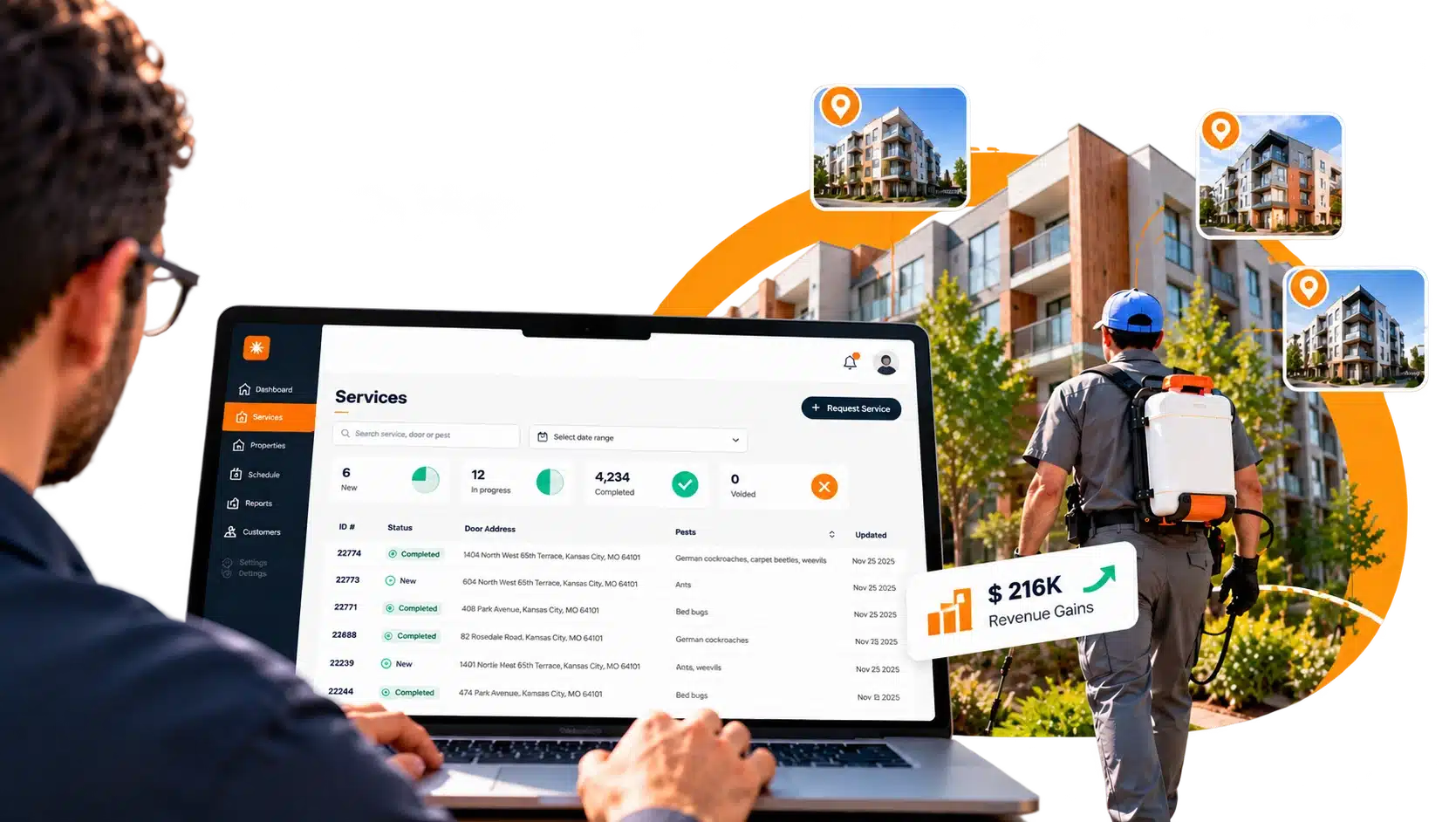
Pest Share is one example of this shift: a pest control platform built for property managers that plugs into existing portfolio operations, connecting resident requests, service coordination, and visibility across markets.
Build Your Shortlist Around Accountability
The best fit for a multifamily portfolio depends on footprint, property type, resident workflow, reporting needs, and how much administration a team wants to keep directly. Orkin, Terminix Commercial, and Rentokil are the natural names for a national shortlist. Regional operators can be a strong fit within their territory. The cleanest question for any option: after the contract is signed, who owns the work?
Frequently Asked Questions
Which pest control companies operate nationally in the U.S.?
Orkin, Terminix Commercial, and Rentokil have the broadest commercial operations nationwide. Regional operators like Massey, Arrow, Plunkett’s, and Truly Nolen have strong density within specific territories but don’t cover every market.
What is the best national pest control company for a multifamily portfolio?
It depends on footprint, multifamily program maturity, and how much administration a team wants to manage directly. A vendor with a dedicated multifamily or property management program is usually a stronger starting point than general commercial coverage.
Can one pest control company service a multifamily portfolio across multiple states?
Some can, but coverage often varies by branch, and per-property contracts can leave the same coordination work in place even with a national brand.
How is technology changing pest control for multifamily portfolios?
Technology can connect pest control more directly with the way a portfolio already operates, helping centralize resident requests, service coordination, reporting, and visibility across properties and markets.
How do large multifamily operators manage pest control across multiple markets?
Many are moving from property-level vendor relationships toward centralized intake and portfolio-wide reporting, with local providers still handling the service itself.
How do enterprise property managers consolidate pest control vendors?
Most consolidate by separating the field service from the program around it: one portfolio-level agreement, centralized resident intake, consistent service rules, and portfolio-wide reporting, with vetted local providers still performing the work in each market. The vendor count drops without the operating model depending on any single company’s branch map.
Should multifamily operators use national or local pest control companies?
Not an either/or. The stronger question is whether the operating model — regardless of which company performs the work — gives the portfolio consistent reporting, resident workflow, and escalation ownership.
Curious What Centralized Pest Control Operations Looks Like Across a Portfolio?
Take a look at how a single program handles resident intake, service coordination, and reporting across every market.